

A Marketing Analysis of PepsiCo’s Unlikely Partnership… and Why It Works
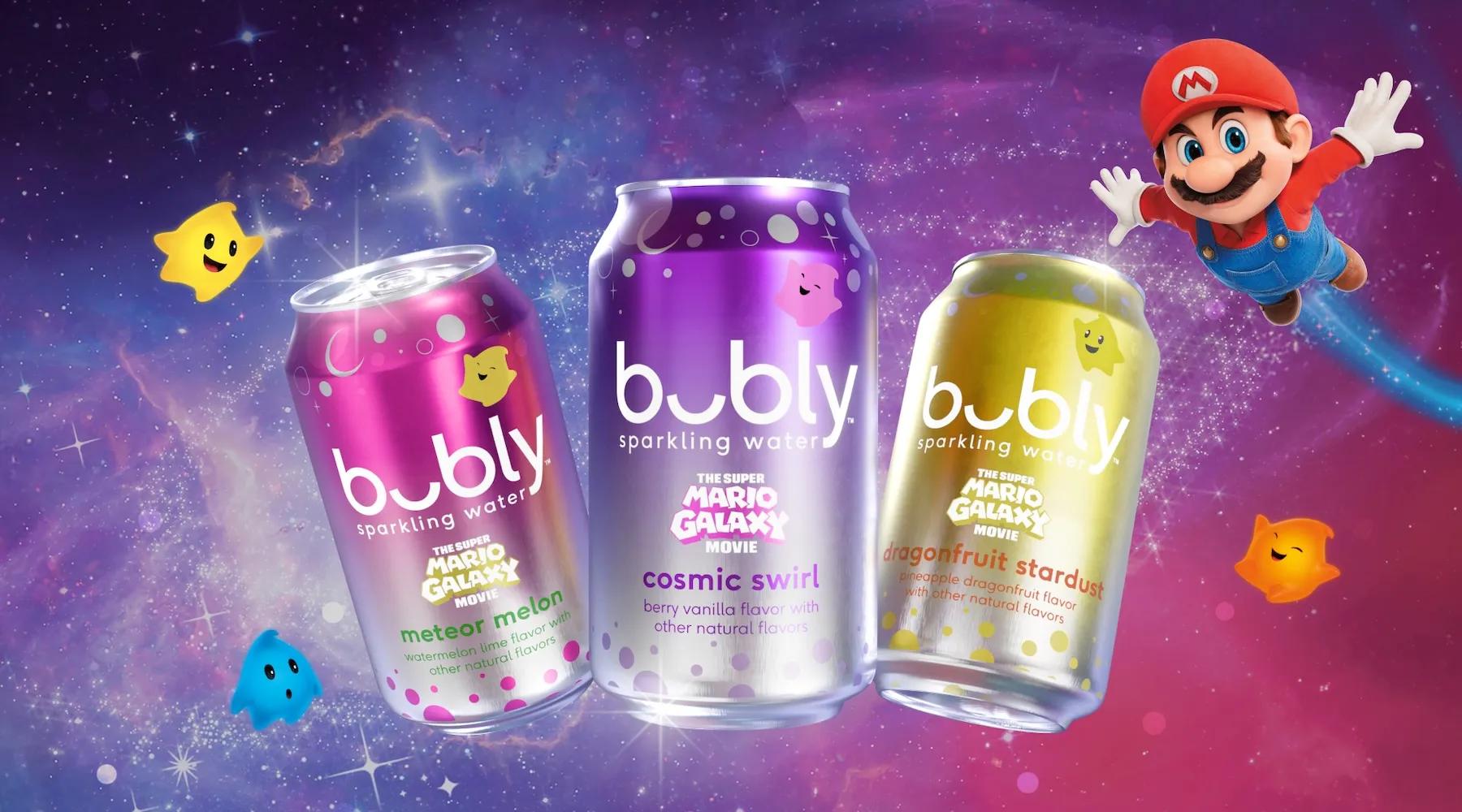
My daughter spotted it before I did. We’d just picked up groceries and she came running over, eyes wide: “Mom, is this for kids?! There’s Bowser on it!” I was half-convinced they’d swapped out my sparkling water for a Capri-Sun. When I finally looked at the cans, my first thought was the same as hers… this is a strange fit. A zero-calorie sparkling water… dressed up like a Nintendo game? But then I thought about the busted Nintendo 64 my mother-in-law dragged over from England, still in my husband’s possession despite arriving in about a dozen pieces. It’s sitting on a dresser because how can we throw away this legendary console? Mario on the NES was iconic: easy to play, multiple levels, entertaining, and good clean fun all at once. That’s when it clicked: this partnership isn’t targeting my daughter at all. It’s targeting us, the millennials.
At first glance, Bowser on a zero-calorie sparkling water feels odd. But look closer at the promotion rules: you must be 18 or older to enter the sweepstakes.
TAKEAWAY: PepsiCo isn’t talking to kids. They’re talking to you.
The Setup
Bubly, PepsiCo’s flagship flavored sparkling water brand, partnered with the Super Mario Bros. film and the broader Nintendo franchise for a limited-time promotional campaign. On the surface, it looked like a movie tie-in. Underneath, it was a sophisticated, multi-layered growth play built specifically around the millennial consumer.
The mechanics were unusually detailed for a beverage campaign:
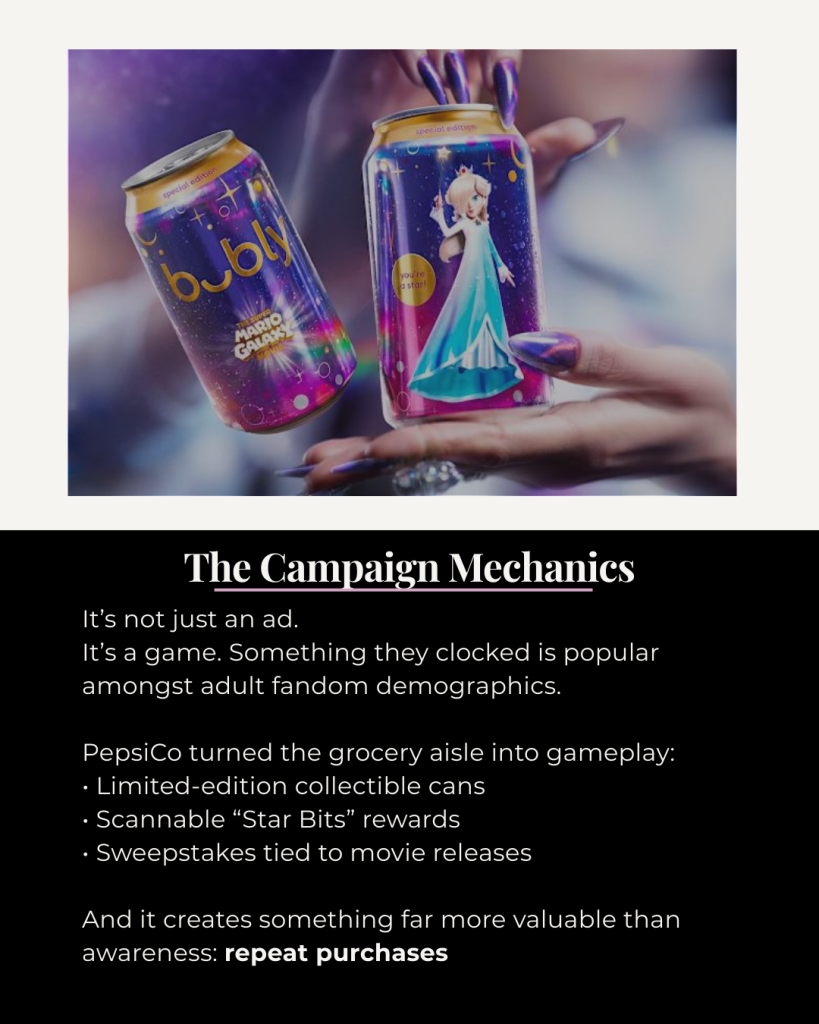
- Limited-edition character-themed can designs featuring Bowser, Mario, Peach, Rosalina, and more
- A ‘rare pack’ treasure hunt seeded across retail locations, creating collectible behavior by design
- Scannable ‘Star Bits’ on packaging that unlocked redeemable points
- A sweepstakes grand prize trip modeled on the franchise’s own quest structure
NOTE: The sweepstakes terms required participants to be 18+. This is not an accident. PepsiCo operationally routed the engagement to adult consumers, even while the movie drew family audiences. The gameplay was always for grown-ups.
Who Are They Really Targeting?
At first glance this looks like something you’d see on Capri-Sun or Doritos, right? Something meant to get kids excited about the movie. But the data tells a different story.
The 2023 Super Mario Bros. film posted strong numbers across demographics, but the most telling data point was its over-representation among 18–34 year olds. The audience was over 50% adults in that range, with roughly 60% skewing male. This is the millennial gamer…you know, the person who grew up with a cartridge in their hand and now stands in a grocery aisle deciding what sparkling water to throw in the cart.
PepsiCo isn’t chasing kids here. They’re chasing the nostalgia economy, and it runs through two very distinct lanes:
-
Millennial parents: nostalgia layered onto a movie-night grocery trip. The kids spot Mario. The parents remember Mario. And the Bubly ends up in the cart.
- Childfree millennials: nostalgia plus gamified collectible hunting plus shareable social content. Pew Research (2023) found that 47% of adults under 50 without children say they’re unlikely to ever have them, which is up from 37% in 2018. This is a large, spending-capable audience that mainstream family marketing routinely ignores.
Bubly is targeting both. One product, two distinct psychological entry points.
Marketing Science – Part 1: Penetration
Marketing science tells us that brands grow by reaching more buyers, not by deepening loyalty with a narrow base. You get more growth from thousands of people buying your product once than from three loyal customers buying it on repeat. Brands grow by reaching more people.
We call that market penetration. Think of it like water seeping through cracks until everything is wet. Yes, visualize marketing the way I do.
Along the way, millennials shifted toward healthier choices, fueling the rise of sparkling water brands like LaCroix. But bubly still has significant room to grow its audience. That’s exactly what this partnership is designed to do….expand the number of people willing to pick up a can for the first time.
Let’s be honest about what this campaign’s KPI stack actually looks like. It’s not impressions. It’s:
• Pre-release hype converted into grocery aisle action
• Repeat purchases driven by collectibles and point redemption
• Social shareability baked into the “rare find” mechanic
That last one is especially clever because people who find a rare can post it. Suddenly the campaign generates free earned media, otherwise known as UGC: user-generated content.
Every lever in this campaign from the IP tie-in, the limited edition, to the gamification is aimed at expanding who walks out of the store with a case. They’re not trying to make you a Bubly superfan. They’re trying to get more people to buy Bubly once. In marketing, that’s penetration strategy and this is the first step in this campaign.
The Brand Choice: Why Bubly, and Not Doritos?
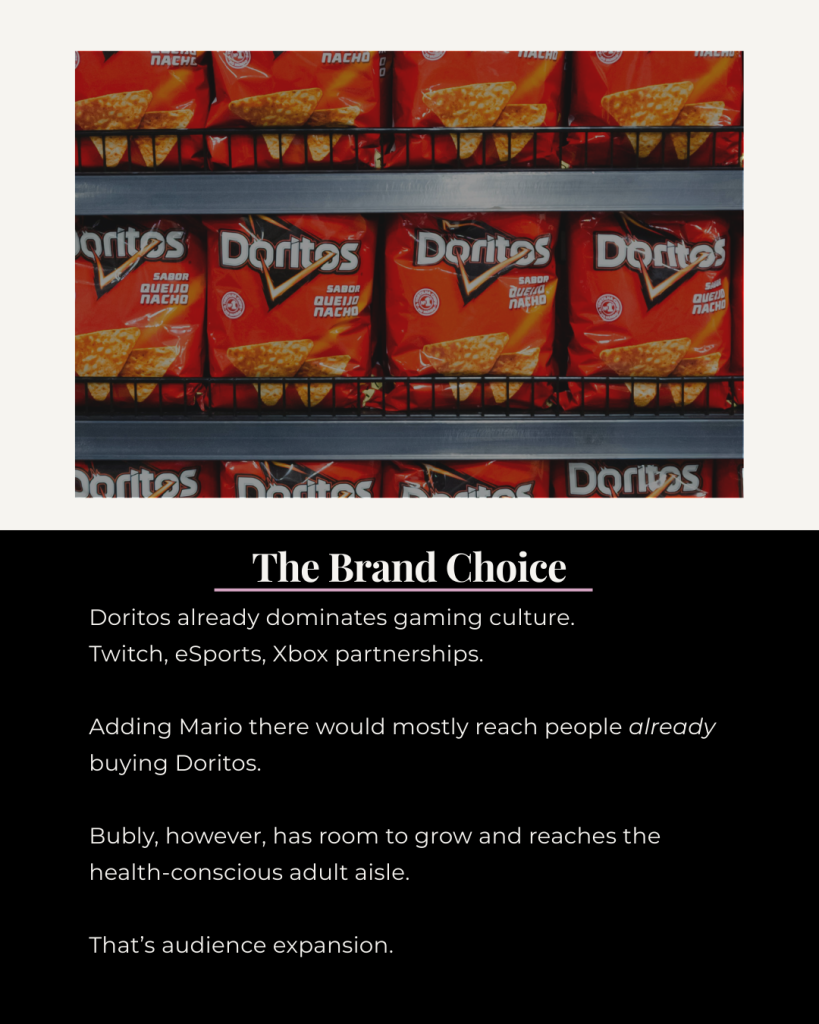
It’s a fair question. Doritos has owned gaming culture for years, such as Mountain Dew, Xbox, eSports, Twitch, Call of Duty. They already live in ‘teen gamer snack’ territory. Adding Mario there would have been preaching to the choir, not expanding the congregation. From a growth standpoint, that’s low incremental value. Doritos would’ve gotten brand heat but few new buyers.
Bubly, on the other hand, gains something Doritos couldn’t: a genuine audience extension. Mario’s brand DNA is wholesome, nostalgic, and cross-generational. Literally, the opposite of Doritos’ loud, edgy, chaotic energy. There’s no brand tension with bubly’s clean, better-for-you proposition. The partnership feels natural rather than forced.
This is where the halo effect comes in. Bubly’s zero-calorie, no-sweetener formula gives it a ‘better-for-you’ halo, which is a perception of health-consciousness that Doritos simply doesn’t carry. That halo is what allows PepsiCo to participate in a family film moment without any of the optics baggage that comes from pushing sugar-forward beverages near kids. When a brand with health credibility partners with beloved family IP, the association lifts both. Mario’s wholesomeness reinforces Bubly’s clean image. Bubly’s health halo makes Mario feel like a grown-up, responsible choice, and not a junk food tie-in.
That’s audience expansion in a strategically clean way a Doritos partnership never could have been.
STRATEGIST’S NOTE: Bubly gets to show up in the family aisle, the nostalgia aisle, and the health-conscious aisle, all at once.
Marketing Science – Part 2: Collectible Economics
Penetration gets new buyers in the door. But a completely separate growth engine keeps them coming back: collectible economics.
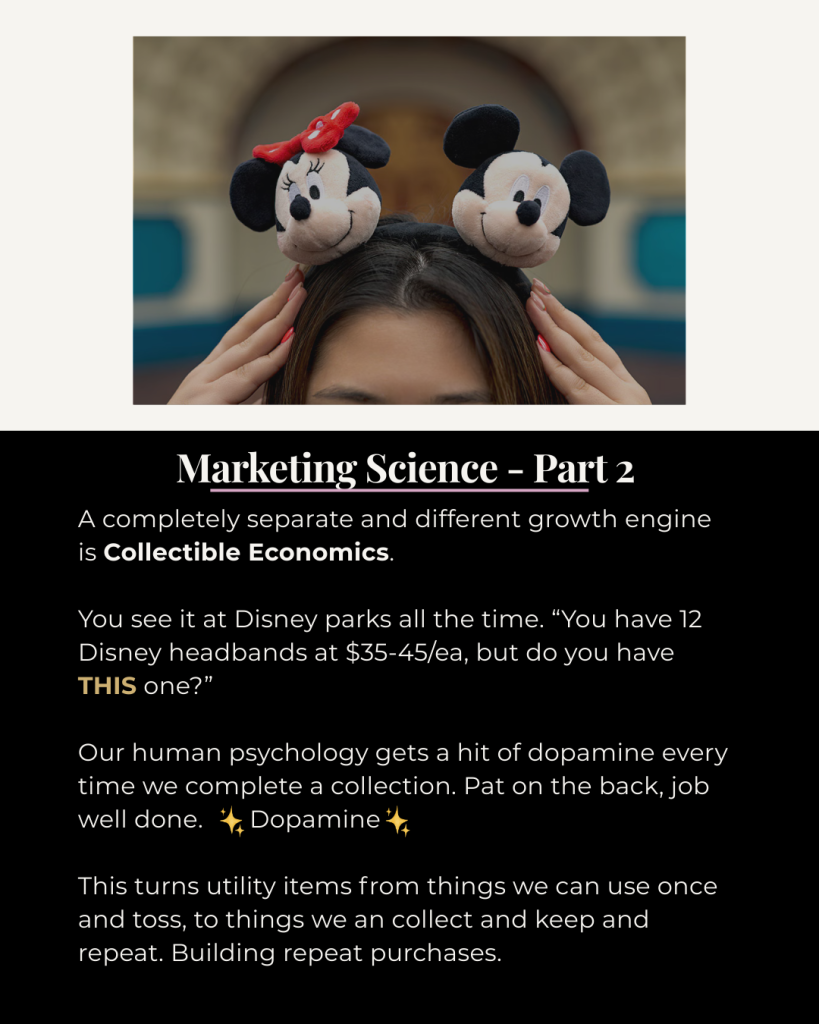
You see it at Disney parks all the time. You might already own 12 Disney headbands at $35–45 each…. but do you have THIS one? Our brains get a hit of dopamine every time we complete a collection. There’s a psychological reward in the act of finding, acquiring, and completing a set that has nothing to do with the utility of the product itself.
This turns a utility item (something you drink once and recycle) into something you hunt, collect, and repeat. It transforms a single transaction into a purchase loop. The rare-pack treasure hunt seeded across retail locations is a direct application of this principle. Finding the Rosalina can isn’t just lucky. It feels like winning.
The execution here emphasizes collectible behaviors and digital redemption that over-index with adult fandom cultures specifically. The same demographic drives Pokémon card resales, limited sneaker drops, and Disney pin trading. PepsiCo didn’t invent this behavior. They just plugged Bubly into it.
The Campaign Mechanics: Retail as Gameplay
It’s not just an ad. It’s a game. The Star Bits mechanic is specifically designed to make that second and third purchase feel rewarding, not routine. The campaign’s purchase-linked and reward-linked design was built around a precise KPI stack: incremental units, repeat purchase, and social shareability. Every mechanic in the campaign is engineered to create something far more valuable than brand awareness alone.
The promotion’s limited-time structure (entries through April 16, Star Bits redemption through May 8) also suggests deliberate timing around the film’s post-release window, capturing both the opening-weekend rush and the long tail of repeat viewers. This isn’t a campaign that peaks at launch and fades. It’s designed to sustain purchase behavior across the full theatrical run.
Why It Works (Even If It Looks Odd at First)
PepsiCo stacked two growth engines into one campaign: market penetration (reach) and collectible gameplay (for repeat purchases). That’s what elevates this beyond a cute movie tie-in into one of the cleaner co-branding executions in recent CPG memory.
- Penetration: Mario nostalgia pulls new buyers into the Bubly aisle. People who normally grab LaCroix or Polar try it once. Audience expanded.
- Collectible Gameplay: Limited cans, Star Bits, and sweepstakes turn the purchase into a game… inducing repeat buys from the same consumers who just tried it for the first time.
- Better-for-you halo that sidesteps ‘kids advertising’ scrutiny… strategically clean for PepsiCo’s public positioning.
- Purchase-linked mechanics that drive repeat behavior, not just brand awareness.
So they targeted Reach AND Repeat purchases. In marketing, that’s a knockout.
It’s easy to look at a Bowser sparkling water and think PepsiCo made a strange call. But when you map the audience, the mechanics, and the brand math, it’s one of the cleaner co-branding executions in recent memory. The 8-year-old in your house might want one. But this campaign was built for the 35-year-old who used to stay up all night trying to beat World 8-4.
Written by Jenni Hilton · Theorie Lounge Marketing · McKinney, TX